


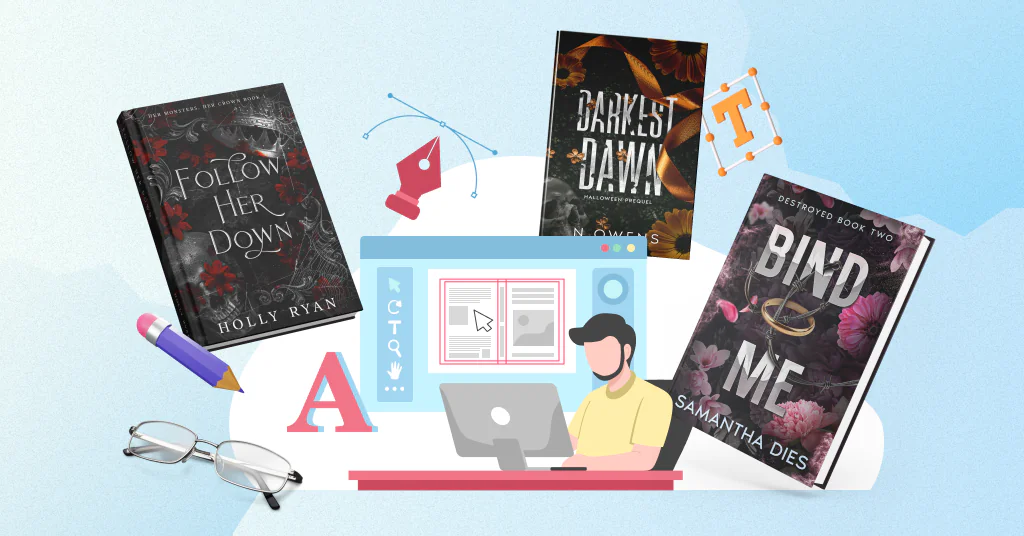

You finished the manuscript, and even survived editing. Now you have one more big decision: who designs your book cover?
Indie authors usually have three options:
- Design the cover yourself
- Hire a freelance book cover designer
- Work with a book cover design company
Each one can work, and the right pick depends on your budget, your design skills, your publishing goals, your timeline, and how much of the process you actually want to manage yourself.
Price isn’t the only thing to weigh here, though. Your cover needs to signal the genre, attract the right readers, hold up in a tiny thumbnail, meet platform requirements, and hold its own next to other books in your category.
Let’s walk through all three options to find out what is best for you.
Option 1. Design your own cover
DIY is usually the first option authors consider, especially on a tight budget.
And these days, you don’t need serious Photoshop skills. Tools like Canva or BookBrush come with templates and simple editors that make basic cover design pretty accessible. You can play with fonts, colors, and imagery without much design background at all.
What are real advantages of DIY cover design?
- It’s cheap. Many platforms offer free plans or templates, so your upfront publishing costs stay low.
- You have full creative control. You can try as many colors, fonts, and images as you want without having to explain your vision to anyone else.
- You can change things anytime. Want to update the subtitle, move your name, swap the image? Just do it. No need to loop anyone in first.
- It works fine for simple designs. Typography-heavy nonfiction covers, reader magnets, short stories, and smaller projects often don’t need heavy image work.
However, here’s the real challenge: knowing your story isn’t the same as knowing how to sell it visually. A cover can capture a scene from your book perfectly and still look nothing like the successful books in its genre.
Solid cover design calls for an understanding of:
- Genre and subgenre conventions
- Typography and font pairing
- Composition and visual hierarchy
- Color theory
- Image editing
- Thumbnail readability
- Current market trends
- Print specifications
- Image and font licensing.
DIY can also take more time than you expect. Instead of working on your launch, your newsletter, your ads, or your next book, you might spend hours in design software wondering why the typography still looks off.
Still, if you want to design your book cover yourself, you may find this list of DIY design tools helpful.
Option 2. Hire a freelance designer
If DIY isn’t for you, the next step up is hiring an independent designer. You get professional skills while still working directly with one person.
What is the upside of hiring a freelancer?
- You can find a style that matches your book. You can browse portfolios until you find someone who specializes in exactly that.
- You talk directly to the person doing the work. That often makes the collaboration feel personal and flexible.
- Prices span a wide range. Freelance marketplaces have designers at every experience level, so you’ve got real options.
- You get professional skills. An experienced cover designer handles typography, composition, image editing, and technical files far more confidently than a first-timer would.
But what is the downside of hiring a freelancer?
The main challenge is finding the right person. A strong graphic designer isn’t automatically a strong book cover designer. Covers have their own marketing rules, and ideally your designer knows both the visual craft and your genre.
That means you’ll likely spend time:
- Comparing portfolios
- Reading reviews
- Checking if they’ve worked in your genre before
- Discussing licensing
- Confirming how many revisions you get
- Checking which files are included
- Nailing down deadlines and availability
Quality can also vary a lot across big marketplaces. Then there’s availability. A freelancer is one person. They can get booked up, take time off, switch careers, or just be unavailable when you come back six months later to book two.
Option 3: Hire a book cover design company
The third option is working with a company that specializes in book covers.
On the surface, it looks a lot like working with a freelancer. You send a brief, get a design, give feedback, and receive final files. The real difference is what’s happening behind that process.
A design company usually runs on an established workflow, with a team of designers and managers, experience across many genres, and internal systems for revisions, communication, files, and quality control.
What are the pros of hiring a design company?
- You benefit from more than one person’s experience. Even if a single designer builds your cover, they work within a bigger system that accumulates knowledge across genres, client requests, and market trends.
- Cover design is their specialty. A team that lives and breathes publishing visuals sees genre patterns constantly. They know which styles dominate different niches and which choices make a book feel out of place on the shelf.
- The process is more predictable. Companies have clear steps for submitting a brief, reviewing drafts, requesting revisions, and getting final files.
- There’s more continuity. If one designer is out, the service doesn’t grind to a halt. That matters for authors publishing a series. A company can hold onto previous project context and pull in other team members as needed.
- You get more support around the cover itself. A cover project is rarely just one JPG. You might need an ebook version, print wrap, spine text, barcode placement, different trim sizes, promo assets, or extra adaptations later.
- You spend less time hunting for specialists. Instead of digging through dozens of portfolios, you pick a service and let the company assign the work internally.
However, what cons can you face? A few things are worth keeping in mind.
- The process can feel more structured. If you prefer an informal back-and-forth where you message your designer directly throughout the day, a freelancer might feel closer to that.
- Prices vary a lot between companies. Some studios position themselves as premium, others focus on affordable options for indie authors. A company isn’t automatically the pricier choice, but it’s worth comparing what each package includes.
And you still need to do your homework. Review the portfolio, check whether they’ve worked in your genre, read the revision policy, and review the licensing and copyright terms before committing.
By the way, check out our blog post to find out which book cover design companies to avoid at all costs.
So, which one should you pick?
There’s no single right answer here. A tight budget paired with design skills makes DIY a reasonable choice. Finding a freelancer whose portfolio matches your genre and preferring one-on-one work also works well.
But for professional design, genre expertise, reliability, and a ready-made workflow, a book cover design company usually delivers the most complete package. That matters even more once you start treating publishing as a long-term career instead of a one-off project.
What option works best for you in your experience? Share in the comments below.


